



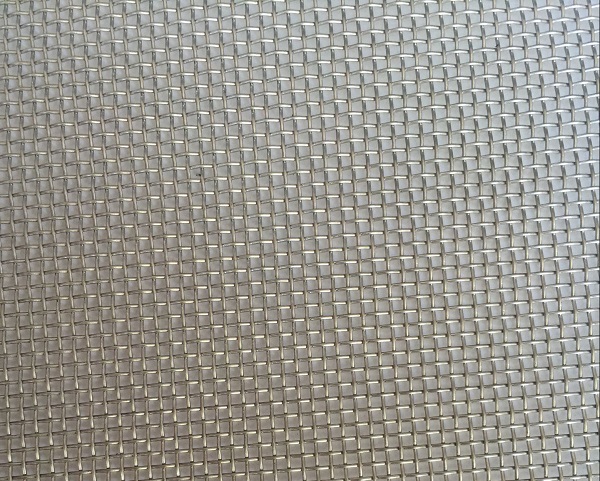
Duplex stainless steel wire mesh is woven from stainless grades containing both austenitic and ferritic phases. It is considered when conventional stainless mesh may not provide the required combination of strength and resistance to pitting, crevice corrosion or chloride-related stress corrosion cracking. For chemical processing, desalination and oil-and-gas equipment, selecting “duplex” is only the starting point. Buyers must match the grade, aperture, wire diameter, weave and fabricated component design to the actual fluid chemistry, temperature, pressure and cleaning method.
Article Summary
- Lean duplex, 2205 duplex and super duplex grades are not interchangeable in aggressive service.
- Mesh count does not equal aperture or filtration rating; wire diameter and weave must also be specified.
- Duplex mesh may be used inside process equipment, but it is not itself a pressure-vessel shell or heat-exchanger tube.
Why Specify Duplex Wire Mesh?
Duplex stainless steels combine ferritic and austenitic microstructures. Strength and localized-corrosion resistance differ substantially between grades and environments. An Outokumpu overview of duplex stainless steel separates lean, standard and super duplex grades.
For woven mesh, these properties can support handling and service in chloride-bearing liquids or process chemicals. They do not make every grade suitable for every acid, chloride concentration or temperature. Deposits and frame crevices can create conditions different from the main process stream.
Selection should therefore begin with the complete operating environment, not a general request for “corrosion-proof mesh.”
Match the Grade to the Exposure
HIGHTOP lists LDX 2101, 2205, 2507 and Zeron 100. “2101” and “LDX 2101” should not automatically be treated as unrelated grades; LDX 2101 is associated with the lean-duplex UNS S32101 family. State the applicable standard and exact designation.
| Grade Family | Selection Context | Important Limitation |
|---|---|---|
| LDX 2101 / 2101 | Lean-duplex option for moderate corrosion conditions where duplex strength or stress-corrosion resistance is useful | Do not assume it offers the same localized corrosion resistance as 2205 or super duplex grades |
| 2205 | Common duplex choice for many chloride-bearing and chemical-processing environments | Suitability still depends on chloride level, temperature, pH, contaminants and crevice conditions |
| 2507 | Super-duplex grade considered for more aggressive chloride exposure, including demanding seawater-related service | Higher alloying does not remove the need for compatibility review or correct fabrication |
| Zeron 100 | Proprietary super-duplex grade used for severe corrosive conditions | Confirm the exact grade designation, wire availability and required documentation before ordering |
A more highly alloyed grade can increase cost and affect wire availability. Select the grade that meets verified service and fabrication requirements.
Mesh Count Is Not a Filtration Specification
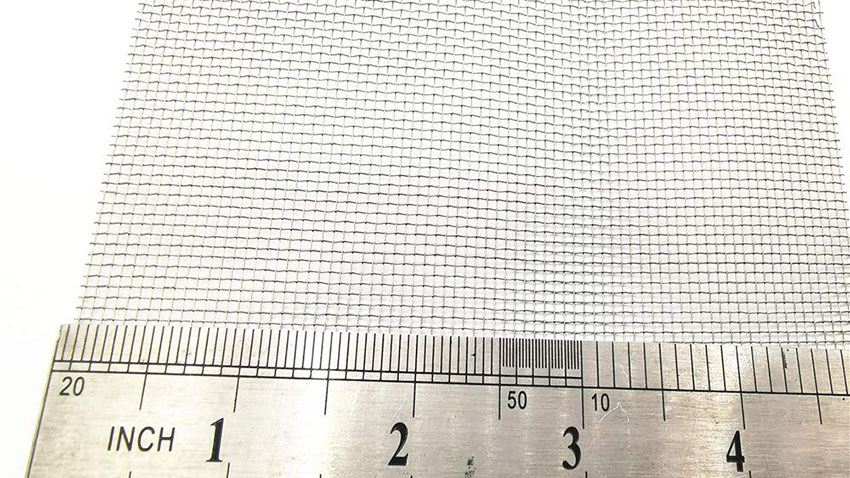
The available product range is stated as 3–500 mesh, with wire diameters from 0.025 to 2.2 mm. These are overall ranges, not a promise that every mesh count can be combined with every wire diameter or duplex grade.
For conventional square mesh, mesh count indicates openings per linear inch. Aperture also depends on wire diameter, so two 40-mesh products can have different clear openings and open areas.
For filtration or screening, the inquiry should state:
- Required clear aperture or target particle-retention objective
- Mesh count and wire diameter
- Plain or twill weave
- Permitted dimensional tolerances
- Required roll width, length and quantity
- Flow direction, pressure difference and cleaning method
The opening is not an absolute filtration rating. Particle shape, deformability and differential pressure can change what passes through.
Plain Weave or Twill Weave?
In plain weave, each weft wire alternates over and under each warp wire. This produces regular square openings and is commonly used where the required wire-to-aperture combination can be woven reliably.
In twill weave, wires pass over and under multiple adjacent wires in an offset pattern. It can accommodate some heavier-wire and higher-count combinations that are difficult in plain weave. The two should not be substituted merely because their mesh counts match.
If filtration behavior is critical, compare aperture, wire diameter, open area and weave rather than using mesh count alone.
Understand the Role of Mesh Inside Process Equipment
Duplex mesh may form screens, filter layers, demister components or separators inside heat exchangers, desalination systems and pressure vessels. There it performs screening, separation or support.
It is not the pressure-bearing vessel wall or a heat-exchanger tube. Those components require separate product forms, calculations, standards and inspections. Their material does not automatically determine the internal mesh alloy because exposure may differ.
For sour service, grade, condition, fabrication and hardness may be governed by the project specification. A general corrosion-resistance claim is insufficient for approval.
Conditions That Can Change the Selection
Provide the process medium and all relevant contaminants. Chloride concentration alone may be insufficient because temperature, pH, dissolved oxygen, flow velocity and shutdown conditions can alter corrosion risk.
Identify whether cleaning uses backwashing, chemicals, steam, ultrasonics or brushing. Cleaning chemicals may be more aggressive than the process fluid, while handling can damage fine wires.
For framed or welded mesh, review joining and dissimilar-metal contact. Heat input and surface condition can affect duplex microstructure, so fabrication procedures must suit the grade.
Comparing Quotations
A valid comparison requires more than matching “2205, 100 mesh.” Each quotation should identify:
- Standardized alloy designation, not only a trade name
- Mesh count, aperture, wire diameter and weave
- Roll dimensions and edge condition
- Material and dimensional documentation required
- Any cutting, forming or welded fabrication
- Packaging and labeling requirements
The listed minimum is one roll, with widths of 0.1–1.5 m and lengths of 10–100 m. Confirm the grade-and-mesh combination and current stock before relying on these overall ranges or the listed five-day stock dispatch.
Discussing a Duplex Mesh Requirement with HIGHTOP
HIGHTOP Wire Mesh supplies duplex stainless steel wire mesh in plain and twill weaves, subject to grade and specification feasibility. Rolls are protected with inner kraft paper and outer plastic cloth, then placed on a wooden pallet or in a wooden case. Send the operating conditions, alloy designation, aperture, wire diameter, roll size and documentation requirements for review.
Frequently Asked Questions
Is 2507 Always Better Than 2205?
No. 2507 is intended for more aggressive conditions, but it may add unnecessary cost where 2205 is adequate. Selection requires actual chemistry, temperature, crevice conditions and fabrication details.
Does 500 Mesh Mean 500-Micron Filtration?
No. Mesh count is openings per linear inch in applicable square weaves, not a micron rating. Aperture must be calculated or specified using both count and wire diameter, then verified for the weave.
Can Duplex Mesh Be Welded into a Filter Component?
Potentially, but welding procedure, heat input, filler selection, joint design and surface restoration must suit the grade and service. Weldability of duplex steel is not a blanket approval for every fine-wire assembly.
Get Quote
We would like to hear from you. Please get in touch with us by filling out the contact form below, we will get back to you shortly.

Comments are closed.